
What are the published benchmarks?
| Statistic | Figure | Source |
|---|---|---|
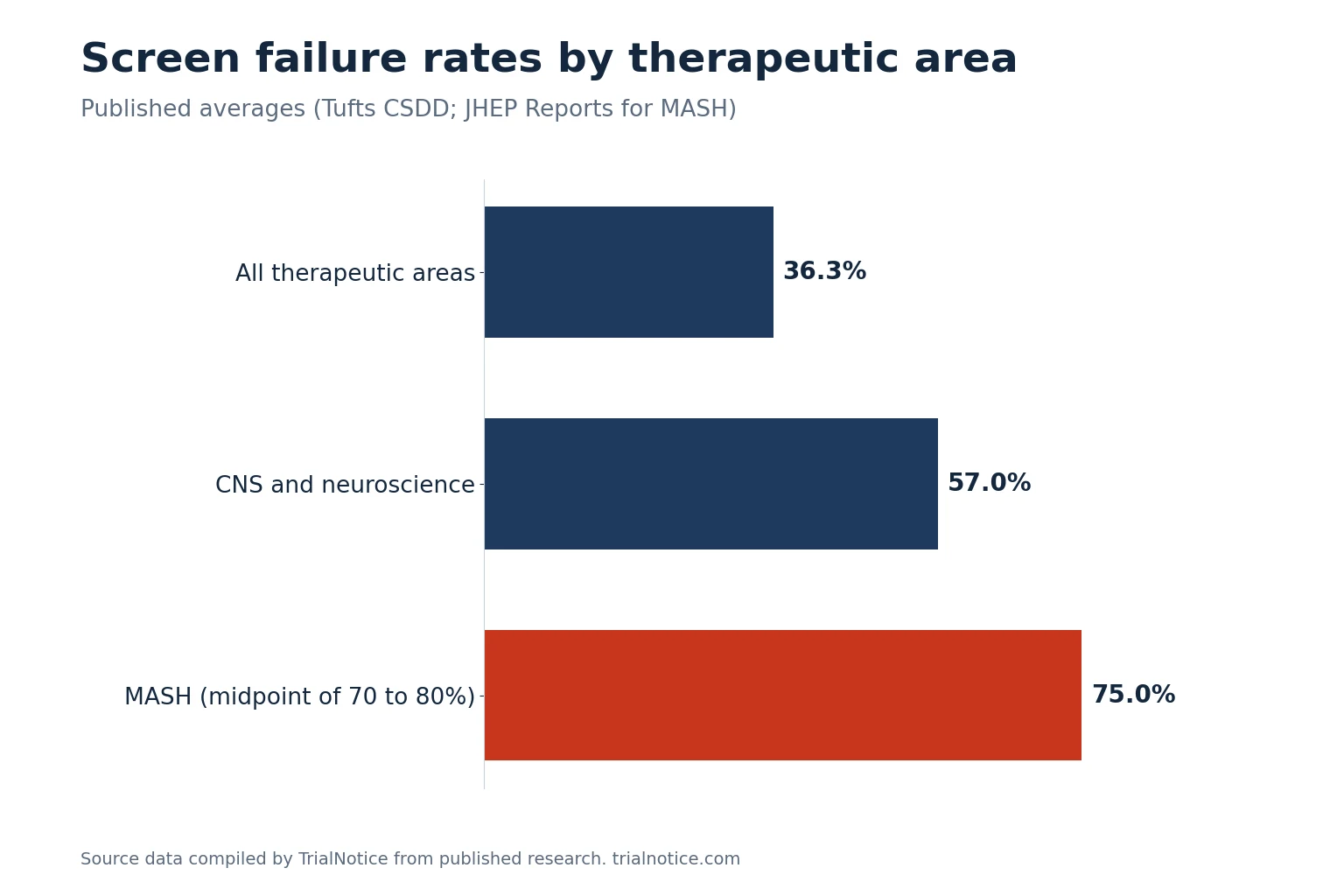
| All therapeutic areas, Phase II and III | 36.3% (34.7% in 2012) | Tufts CSDD |
| CNS and neuroscience | 57% (29.5% in 2012) | Tufts CSDD |
| MASH therapeutic trials | 70 to 80% | JHEP Reports |
| Alzheimer's patients estimated to be trial eligible | 10 to 27% | Alzheimer's Association and NIA |
| Patients screened per randomized patient, 25 practice trial | 7.2 average (1.4 to 19.8) | PMC |
How do you calculate your own screen failure rate?
Screen failure rate = patients who signed consent but did not randomize ÷ patients who signed consent. Track it per study and per patient source. Rates by source show which channels send patients who actually qualify.
Why does the rate matter financially?
88% of sites say screen failures are not sufficiently covered (SCRS), and 42% say screen failure terms never or rarely cover actual screen fails (SCRS). Use your expected rate when negotiating, not the sponsor's assumption. See how to negotiate a clinical trial budget.
How do sites bring the rate down?
By improving who arrives at screening. Patients referred by a physician who already knows their diagnosis, medications, and history are prequalified on the criteria behind most failures. See how to lower screen failure rates.
Get your study in front of the right local physicians
TrialNotice builds a physician referral pipeline around one active study. We identify relevant local physicians within driving distance of your site, send study aligned direct mail, follow up by email and LinkedIn, track engagement with recipient level QR codes, and route warm responses into your site team's workflow.
Talk to TrialNoticeSources
- Applied Clinical Trials, "Can Recruitment and Retention Get Any Worse?" (Tufts CSDD screen failure study)
- "Non invasive tests for fibrotic MASH for reducing screen failure in therapeutic trials," JHEP Reports, PubMed
- Alzheimer's Association and National Institute on Aging national recruitment strategy announcement (2018)
- "Site specific factors associated with clinical trial recruitment efficiency in general practice settings," PMC
- Society for Clinical Research Sites, Site Finances White Paper (2024)
- SCRS 2024 Global Site Landscape results, Site Solutions Summit